ONLY PRESCRIPTION IS MORE COWBELLA LITTLE SPACE FOR YOUR NEXT CHAPTER ↗
More Cowbell
Cover of 7-7-7 Rule for Game Design (Paperback) FROM THE BOOK CATALOGUE

Game Design

7-7-7 Rule for Game Design (Paperback)

By Kenwright

A practical framework that helps game creators shape mechanics and player experiences with clarity and confidence.

WHAT THE PUBLISHER HIGHLIGHTS

  • Learn a clear framework for structuring game ideas.
  • Improve your ability to design engaging gameplay loops.
  • Develop stronger decision‑making skills in the design process.

Opens www.amazon.com. Check the retailer for current prices, formats, delivery, and availability.

Catalogue reference: 4fc8a454aa3f2849

INSIDE THE BOOK

About this book

The 7‑7‑7 Rule for Game Design breaks down the creative process into three simple layers that help designers focus on what truly matters: player goals, core mechanics, and moment‑to‑moment engagement. Through examples, exercises, and real‑world insights, the book shows how constraints can unlock creativity and lead to more polished, intentional game experiences. Whether you're prototyping your first idea or refining a complex system, the 7‑7‑7 rule offers a reliable guide for making design decisions that feel purposeful and player‑centered.

From the publisher’s description

  • Learn a clear framework for structuring game ideas.
  • Improve your ability to design engaging gameplay loops.
  • Develop stronger decision‑making skills in the design process.
  • Gain confidence through practical, repeatable design methods.

Explore the topics

ANOTHER PERSPECTIVE

Readers, in their own words

Explore reviews
Reader review5

Finally, an explanation that clicks

The clearest explanation of game design I have come across.

There is a particular kind of technical book that is dense without being difficult, and this is one of them. Some terminology is introduced without much ceremony; I had to look a few things up along the way. A couple of chapters felt like they could have been merged, but that is a minor complaint. The exercises at the end of each chapter are worth doing — they caught a few misconceptions I did not know I had. Worth the money and the reading time, without hesitation.

Grace SmithMobile developer · Barcelona, ES
7-7-7 Rule for Game Design
Reader review5

This is the one to get

Worth every page. I have already recommended it to two colleagues.

A colleague recommended this and I can see why. It does something that few technical books manage: it respects the reader's time. I found myself making notes in the margins, which is always a good sign. A few of the examples could be more realistic, but the underlying points come across clearly. The author clearly knows the subject deeply and has thought hard about how to teach it. I have already recommended it to two colleagues and will recommend it to more.

Anna ClarkComputer science student · Munich, DE
7-7-7 Rule for Game Design
Reader review5

Highly recommended

Outstanding. I kept finding reasons to come back to it.

I was looking for something that would bridge the gap between tutorials and proper reference material, and this does that well. The examples are small enough to type out and experiment with, which is exactly what I want from a book like this. I found myself making notes in the margins, which is always a good sign. This is the book I wish had existed when I started working with game design.

Thomas EdwardsUniversity lecturer · Boston, MA
7-7-7 Rule for Game Design

BEYOND THE BOOKSHELF

News & ideas

More to explore

THE BOOKS

Add another perspective

View all books
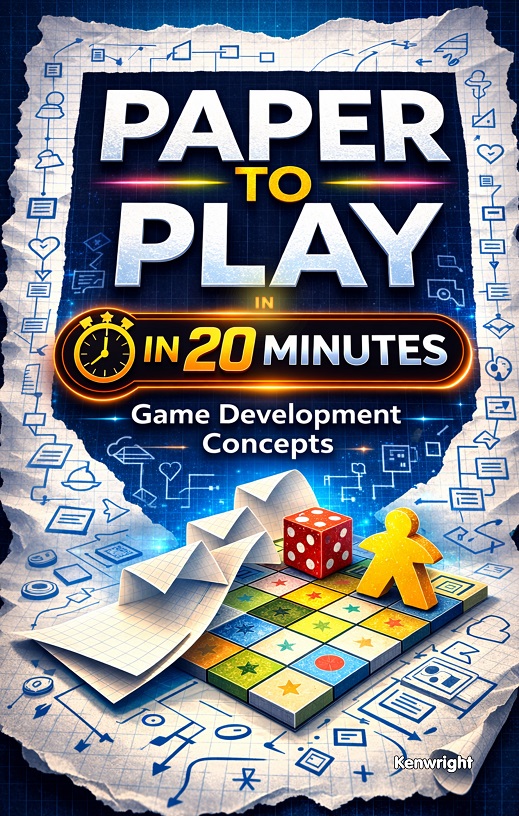
Cover of Paper to Play in 20 Minutes: Rapid Game Prototyping (Game Development Concepts)
Game Development

Paper to Play in 20 Minutes

A hands-on guide to transforming game ideas into playable prototypes in just 20 minutes, focusing on rapid iteration and creative exploration.

Transform abstract game ideas into testable prototypes quickly.

A GOOD READ. THEN AN ENCORE.

Ask what a second perspective could add to your current understanding.

Explore the catalogue